Maryland Workers' Compensation: A Complete Guide
If you were hurt on the job anywhere in Maryland, from Baltimore to the Eastern Shore to the DC suburbs, you have rights under state law regardless of who caused the accident. Maryland's workers' compensation system is designed to get injured employees medical treatment and partial wage replacement without having to prove their employer did anything wrong. But the system runs on strict deadlines, technical forms, and a state agency (not a court) that decides most disputes, and insurance companies regularly contest claims or dispute the value of an injury. This guide walks through how the Maryland workers' compensation system actually works: who is covered, how to file, what benefits are available, how the appeals process works, and the defenses insurers commonly raise.
This page is a general overview. It is not legal advice, and Maryland workers' compensation law includes many exceptions and fact-specific rules that can change the outcome of a particular claim.
If you've been hurt on the job in Maryland and need an experienced workers' compensation lawyer, contact us online or call (410) 995-1515 for a free initial consultation.
Quick Index
Table of Contents
How Maryland Workers' Compensation Works
Maryland's workers' compensation system is governed by the Maryland Workers' Compensation Act, codified at Md. Code Ann., Labor and Employment, Title 9. It is administered by the Maryland Workers' Compensation Commission (WCC), an independent state agency, not a court. Nearly every Maryland employer with at least one covered employee must carry workers' compensation insurance or qualify as a self-insured employer.
The defining feature of the system is that it is "no-fault." Under Md. Code Ann., Lab. & Empl. § 9-501, an employer is liable to provide compensation for an accidental personal injury to a covered employee "regardless of fault as to the cause of the accidental personal injury." That means you generally do not need to prove your employer was negligent, careless, or violated a safety rule. You also do not lose your right to benefits just because you made a mistake or were partly responsible for the accident, subject to a narrow set of statutory exceptions discussed below.
In exchange for no-fault coverage, the system is generally the "exclusive remedy" for a workplace injury, meaning an injured employee typically cannot also sue their employer in civil court for the same injury. There are limited exceptions, such as when an employer fails to carry required insurance or intentionally causes harm, and an injured worker may still have a separate claim against a negligent third party who is not their employer (for example, a subcontractor, property owner, or equipment manufacturer).
To be compensable, an injury generally must "arise out of and in the course of employment." Md. Code Ann., Lab. & Empl. § 9-101(b) defines a compensable "accidental personal injury" using this two-part test. Maryland courts have explained that "arising out of" looks at the causal connection between the job and the injury (was the employee exposed to the risk because of the job), while "in the course of employment" looks at the time, place, and circumstances of the injury (was the employee doing their job, or something reasonably connected to it, when it happened). This is why injuries during a normal commute are usually not covered, while injuries during a work errand, on a job site, or during a work-related task typically are.
Who Is Covered Under Maryland Law
Most people who work for a Maryland employer are "covered employees" under Title 9, and the law presumes a worker is covered unless the employer proves otherwise. That said, coverage is not automatic for everyone, and some categories have their own rules:
- Full-time and part-time employees of a covered employer are generally protected from day one, regardless of immigration status.
- Minors are covered employees under Maryland law.
- Independent contractors are generally not covered, but a worker labeled a "contractor" on paper may still be found to be an employee if the employer actually controls the details of the work. Misclassification disputes are common and fact-specific.
- Sole proprietors and partners are not automatically covered but may elect coverage for themselves by filing written notice with the Commission.
- Corporate officers and LLC members who perform services for compensation are generally covered automatically, though some may elect to opt out.
- Agricultural workers are covered only if their employer meets certain size thresholds (generally three or more full-time employees or a minimum annual payroll), with some specific farm roles excluded even when the employer is covered.
- Domestic workers in a private household are covered once their earnings from that household reach a statutory quarterly threshold, and coverage can also be elected below that threshold.
Because classification and coverage disputes are common (particularly in construction, delivery, gig work, and agricultural settings), it is worth having an attorney review your specific work arrangement if an insurer claims you were not a "covered employee."
Reporting Your Injury and Filing Deadlines
Maryland law imposes two separate deadlines, and missing either one can jeopardize your claim.
1. Written Notice to Your Employer
Under Md. Code Ann., Lab. & Empl. § 9-704, an injured employee is generally required to give written notice of an accidental injury to the employer within 10 days. Under § 9-706, the Commission can excuse a late or missing notice if it finds there was a sufficient reason for the delay, or that the employer or insurer was not prejudiced by it. Even so, prompt written notice (and prompt incident reporting through your employer's normal channels) is the safest practice.
2. Filing the Claim With the Commission
Under Md. Code Ann., Lab. & Empl. § 9-709:
- A covered employee generally must file a claim application with the WCC within 60 days after an accidental personal injury.
- Even if the 60-day window is missed, the Commission may excuse the delay if the employer was not prejudiced, or for another sufficient reason.
- However, there is a hard outer limit: if a claim is not filed within 2 years after the date of the accidental personal injury, the claim is completely barred, with very narrow exceptions (for example, certain fraud or estoppel situations, which can extend the period by up to one year from when the relevant facts are discovered).
- For occupational diseases involving ionizing radiation, the claim must generally be filed within 2 years of disablement or of discovering the disablement was radiation-related.
In death cases arising from a workplace accident, Md. Code Ann., Lab. & Empl. § 9-710 separately requires dependents to file a claim within 18 months of the date of death.
The limitations clock can also be affected by whether the employer filed its own required accident report with the Commission under § 9-707 and § 9-708. Because the rules around tolling, excusal, and what actually counts as "filing" a claim (Maryland courts have held that electronic submission alone does not satisfy the filing requirement) are technical and unforgiving, it is important not to wait to get help after an injury.
How to File a Workers' Compensation Claim in Maryland
While every case has its own wrinkles, a typical Maryland workers' compensation claim generally follows this path:
- Report the injury to your employer immediately, in writing when possible, and seek medical treatment. Tell the treating provider clearly that the injury is work-related.
- File a claim application with the WCC (Form C-1, "Employee Claim Form") within the 60-day window described above. Your employer's insurer will also typically submit its own report of the injury.
- The employer or insurer investigates the claim and either begins paying benefits or files to contest all or part of the claim, generally within a few weeks of the claim being filed.
- If the claim is contested, a hearing is scheduled before a WCC Commissioner. Either side can also request a hearing on specific issues, such as the extent of permanent disability, even in an otherwise accepted claim.
- The Commissioner issues a written order either awarding or denying benefits, and specifying the type and amount of compensation if the claim is accepted.
- Either party may ask for reconsideration or appeal if they disagree with the Commissioner's decision (see the appeals section below).
For our detailed walkthrough of this process, including what documents to gather and what to expect at each step, see How to File a Workers' Comp Claim in Maryland: A 2026 Step-by-Step Guide.
Types of Workers' Compensation Benefits Available
Maryland's workers' compensation system provides several distinct categories of benefits, depending on the nature and severity of the injury.
Medical Treatment
Reasonable and necessary medical treatment for a compensable injury is generally covered, including doctor visits, hospitalization, physical therapy, prescriptions, and medical equipment related to the injury, for as long as treatment remains reasonable and necessary.
Temporary Total Disability (TTD)
If your injury temporarily keeps you from working at all, Md. Code Ann., Lab. & Empl. § 9-621 generally provides for wage-loss benefits equal to two-thirds of your average weekly wage, subject to a statutory maximum tied to the state average weekly wage, which the Maryland Department of Labor updates each year. There is a short initial waiting period before payments begin unless the disability lasts beyond a certain number of days.
Temporary Partial Disability (TPD)
If you can return to work but only at reduced wages or reduced hours while you recover, Md. Code Ann., Lab. & Empl. § 9-615 generally provides compensation equal to half of the difference between your average weekly wage before the injury and your wage-earning capacity during the period of partial disability.
Permanent Partial Disability (PPD)
If an injury leaves you with a lasting impairment that does not totally prevent you from working, Md. Code Ann., Lab. & Empl. §§ 9-627, 9-630, and 9-631 govern how the Commission rates the percentage of impairment and calculates a corresponding number of weeks of compensation (with more serious disabilities compensated over a longer period, and PPD compensation generally paid in addition to, and after, any TTD already paid).
Permanent Total Disability (PTD)
For the most severe injuries, such as the loss or loss of use of both arms, both legs, both eyes, or a combination of two of an arm, eye, foot, hand, or leg, Md. Code Ann., Lab. & Empl. §§ 9-635 through 9-638 govern permanent total disability benefits, which can include an annual cost-of-living adjustment set by the state.
Vocational Rehabilitation
If your injury prevents you from returning to your prior job, Md. Code Ann., Lab. & Empl. §§ 9-670 through 9-675 provide for vocational rehabilitation services, such as vocational assessment, retraining, and job placement assistance, aimed at helping you return to suitable gainful employment. While participating in an approved vocational rehabilitation plan, you generally continue to receive compensation as though you were temporarily totally disabled.
Death Benefits
If a work injury results in death, dependents may be entitled to death benefits and burial expenses, subject to the filing deadlines discussed above.
The WCC Hearing Process and Appeals
Most contested Maryland workers' compensation issues are resolved administratively, not in a courtroom, at least at first.
Hearings Before the Commission
Under Md. Code Ann., Lab. & Empl. §§ 9-713 and 9-714, either party can request a hearing before a WCC Commissioner to resolve disputed issues, such as whether an injury is compensable, the extent of disability, or entitlement to a specific type of treatment. At the hearing, you (or your attorney) can present testimony, medical records, and other evidence, and the Commissioner issues a written decision afterward. Hearings are generally more informal than a civil trial but still follow procedural rules, and scheduling can take a number of months depending on the Commission's caseload.
Requesting Reconsideration
Under Md. Code Ann., Lab. & Empl. § 9-726, a party who disagrees with a Commissioner's decision may file a written motion for rehearing with the Commission within 15 days of the decision.
Appealing to Circuit Court
If a party remains dissatisfied, Md. Code Ann., Lab. & Empl. § 9-737 allows an appeal by filing a petition for judicial review in the circuit court within 30 days after the Commission mails its order. The appeal generally proceeds on the record developed before the Commission, similar to review of other state administrative agency decisions, and further appeals to Maryland's appellate courts are possible after that.
Because both the 15-day reconsideration window and the 30-day appeal window are strict and have been treated by Maryland courts as jurisdictional, it is important to act quickly and involve an attorney as soon as a claim is contested or denied.
Common Defenses Employers and Insurers Raise
Insurance carriers and third-party administrators regularly dispute Maryland workers' compensation claims. Some of the most common statutory and factual defenses include:
- The injury did not "arise out of and in the course of" employment. Under § 9-101(b), the employer or insurer may argue the injury happened outside of work duties, during a personal errand, or otherwise without a sufficient connection to the job.
- Intoxication. Under Md. Code Ann., Lab. & Empl. § 9-506, an employee is not entitled to compensation if the injury was caused solely by their intoxication while on duty, and benefits other than certain medical benefits can be denied if intoxication was the primary cause.
- Willful misconduct. Section 9-506 also bars compensation where the injury was caused by the employee's willful misconduct, though Maryland courts require more than carelessness. The employer generally must show the employee knowingly and intentionally put themselves in a position where injury could be expected.
- Independent contractor or coverage disputes. The employer may argue the injured person was never a "covered employee" in the first place, for example by claiming an independent contractor relationship.
- Pre-existing condition arguments. Insurers frequently argue that some or all of a claimed disability is due to a prior injury or degenerative condition rather than the workplace accident.
- Late notice or late filing. As discussed above, missing the 10-day notice requirement or the claim filing deadlines under §§ 9-704 and 9-709 can be raised as a bar to the claim, though both can sometimes be excused.
Many claims are also contested simply on the extent of disability, meaning the insurer accepts that an injury happened but disputes how serious or permanent it is, which affects how much compensation is owed.
What a Maryland Workers' Compensation Lawyer Does
You are not required to have an attorney to file a Maryland workers' compensation claim, but the deadlines, medical documentation requirements, and hearing procedures are technical, and insurers have their own attorneys working to limit what they pay. A workers' compensation lawyer can help by:
- Making sure notice and claim forms are filed correctly and on time so a technicality does not derail your claim
- Gathering and organizing medical evidence to support the connection between your job and your injury
- Identifying every type of benefit you may be entitled to, including permanent disability ratings and vocational rehabilitation, not just initial wage-loss payments
- Preparing you for, and representing you at, WCC hearings
- Handling motions for rehearing and appeals to circuit court if a claim is denied or undervalued
- Coordinating a workers' compensation claim with a separate third-party injury claim when someone other than your employer contributed to the accident
Under Maryland law, an attorney's fee in a workers' compensation case must be approved by the Commission and is generally a percentage of the benefits recovered, so representation does not require money up front.
If your claim involves questions about your job status after an injury, see our related article, Can I Be Fired for Filing a Workers' Comp Claim in Maryland?
Workers' Compensation Help Near You
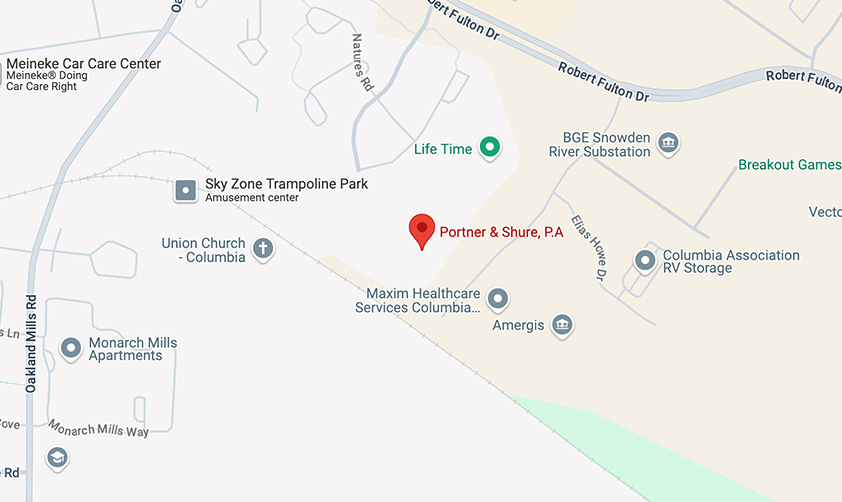
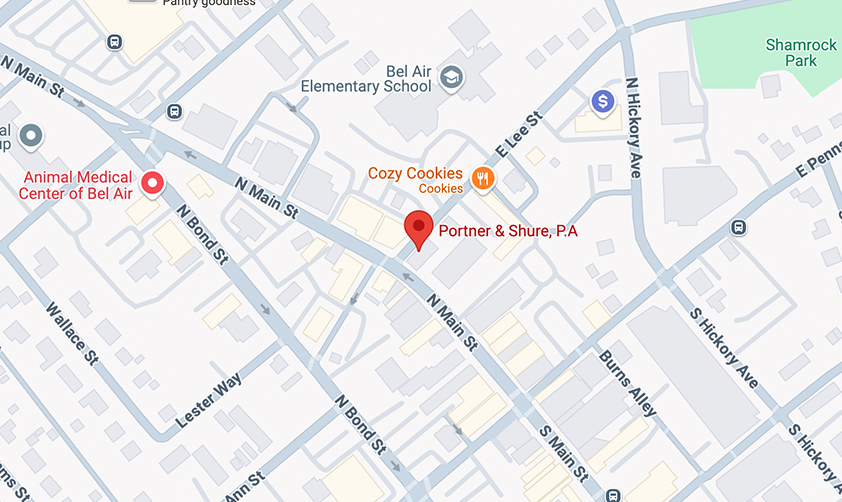
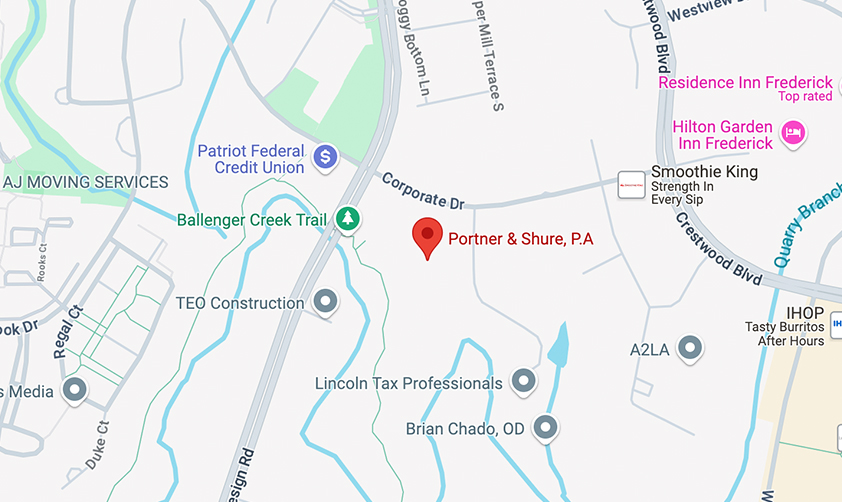
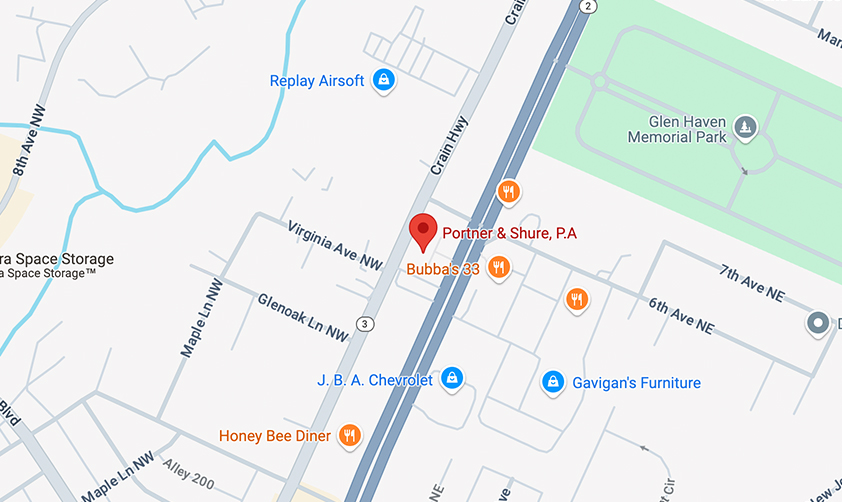
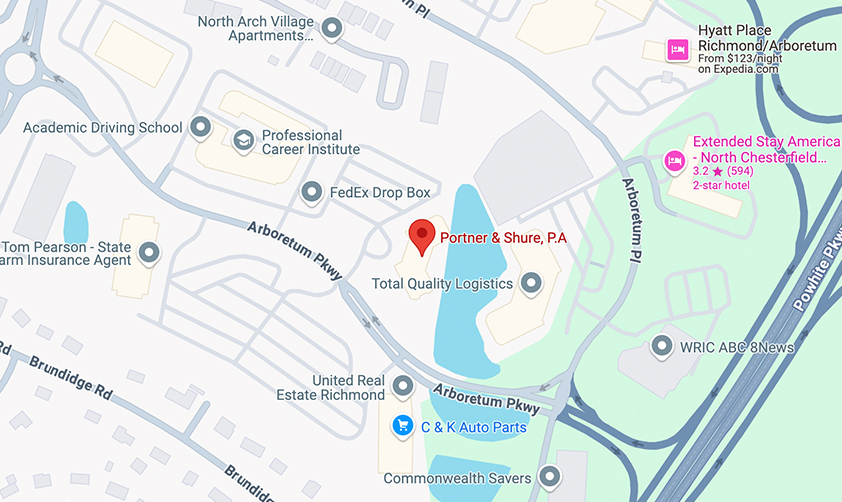
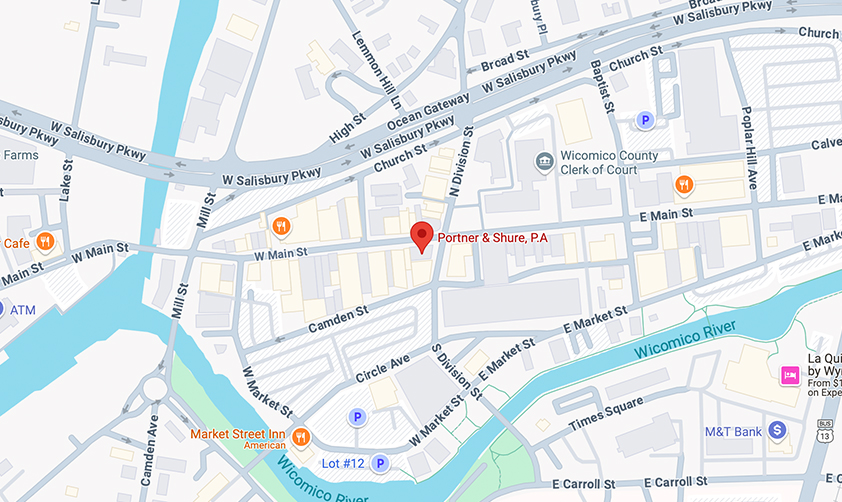
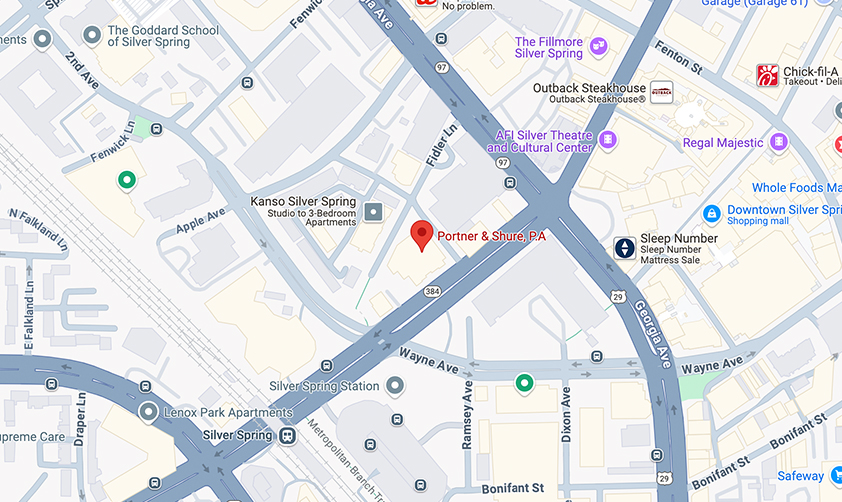
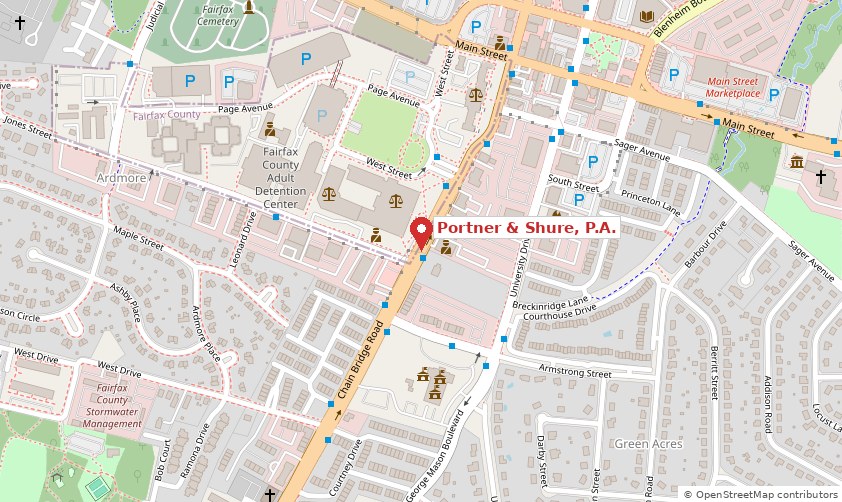
Portner & Shure represents injured workers throughout Maryland, including in these communities:
Wherever you work in Maryland, the statewide rules described on this page apply, and our attorneys handle claims and WCC hearings across the state, not just in these locations.
Frequently Asked Questions
Do I have to prove my employer was at fault to get workers' compensation in Maryland?
No. Maryland workers' compensation is a no-fault system. Under § 9-501, your employer is generally liable for a covered injury regardless of who was at fault, as long as the injury arose out of and in the course of your employment.
How long do I have to report an injury to my employer?
Maryland law generally calls for written notice within 10 days under § 9-704, though the Commission can excuse late notice in some circumstances under § 9-706. Reporting promptly is always the safer course.
How long do I have to file a claim with the Commission?
The general rule under § 9-709 is 60 days from the date of injury, with a hard 2-year outer limit in most cases. Death benefit claims have their own separate deadline of 18 months from the date of death under § 9-710. Missing these deadlines can bar your claim entirely, so it is important to act quickly.
Can I be fired for filing a workers' compensation claim?
Maryland law provides protections against retaliation for filing a legitimate workers' compensation claim. For more detail on how this works and what to do if you believe you were retaliated against, see Can I Be Fired for Filing a Workers' Comp Claim in Maryland?
What if my employer or their insurer denies my claim?
You can request a hearing before a WCC Commissioner under §§ 9-713 and 9-714. If you disagree with the Commissioner's decision, you generally have 15 days to request reconsideration under § 9-726, or 30 days to appeal to circuit court under § 9-737.
What benefits can I receive besides medical treatment?
Depending on your situation, you may be entitled to temporary total disability, temporary partial disability, permanent partial disability, permanent total disability, vocational rehabilitation services, or death benefits for dependents. See the benefits section above for details on each category.
Do I need a lawyer to file a workers' compensation claim in Maryland?
It is not legally required, but the deadlines and procedures are strict, and insurers routinely contest claims or dispute the extent of an injury. An attorney's fee must be approved by the Commission and is generally paid from any award, so most injured workers can get help without paying anything up front.
If you've been hurt on the job in Maryland and need an experienced workers' compensation lawyer, contact us online or call (410) 995-1515 for a free initial consultation.